

Dubai is making it easier for residents to walk, cycle, and connect with public transport as the Dubai soft mobility plan moves forward with a five-year vision to improve everyday journeys across the city.
Approved by Dubai’s Roads and Transport Authority (RTA), the initiative will upgrade infrastructure across 25 residential communities and enhance access around 63 Metro and bus stations by 2030. The goal is to create smoother connections between homes, workplaces, neighbourhoods, and public transport, making short-distance travel more convenient without relying on private cars.
The plan focuses on solving the common “first- and last-mile” challenge, which refers to the journey between a person’s home or destination and a public transport station. By improving these connections, Dubai aims to encourage more residents to combine walking, cycling, and shared mobility options with the city’s existing transport network.
Better walking and cycling routes across Dubai communities
As part of the initiative, RTA will introduce a range of upgrades around residential areas and transport hubs. These include wider pedestrian paths, dedicated cycling tracks, shaded walkways, safer crossings, bicycle parking areas, and improved pick-up and drop-off zones.
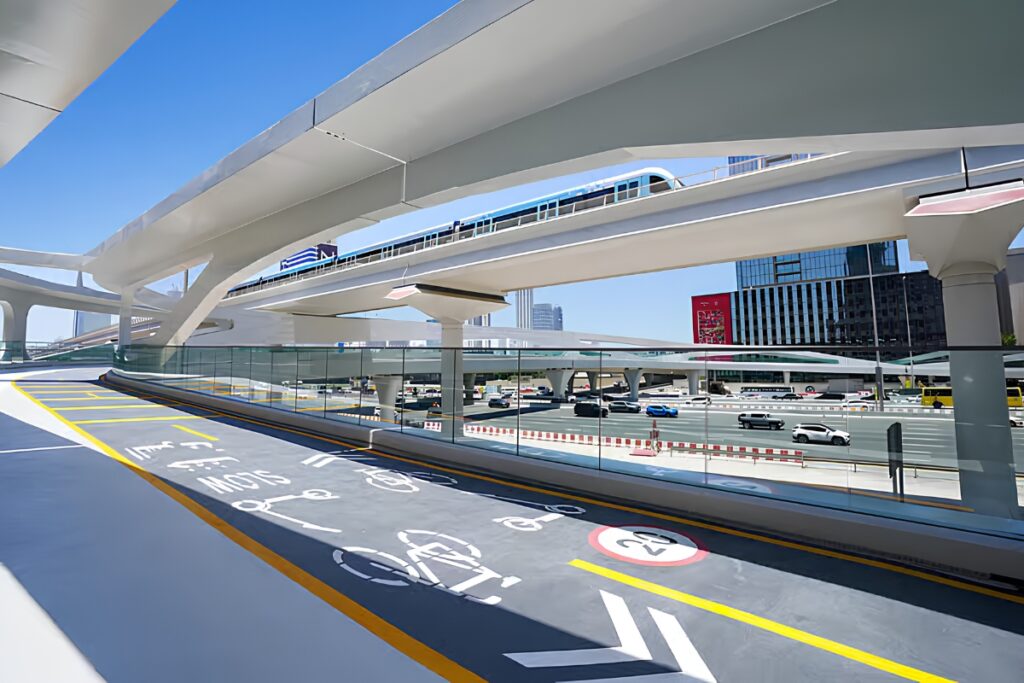
Accessibility is also a key focus, with specialised designs planned to support People of Determination. The upgraded areas will include rest spaces, landscaping, and facilities for shared mobility services such as bicycle and e-scooter stations.
Work is already underway in areas including Dubai Marina, Naif, Al Rigga, Al Murar, and Al Muraqqabat. The plan will build on completed projects in neighbourhoods such as Al Karama, Al Barsha, Al Qusais, Abu Hail, Al Mankhool, and Al Khawaneej.
Supporting Dubai’s vision for a more connected city
The soft mobility expansion forms part of the wider Dubai 2040 Urban Master Plan, which aims to create more accessible and people-friendly neighbourhoods. The long-term goal is to bring essential services and daily needs closer to residents, with more areas designed around walking, cycling, and public transport access.
The demand for alternative mobility options has continued to grow, with Dubai recording 342 million pedestrian journeys, 57.3 million cycling trips, and 39.6 million e-scooter trips in 2025. By 2030, the initiative aims to connect a total of 34 communities through improved soft mobility infrastructure. With upgraded routes, safer crossings, and better links to public transport, Dubai’s neighbourhoods are set to become easier to explore and more convenient for everyday movement.