

Dubai Toyota Building has been a familiar part of Sheikh Zayed Road for more than five decades, watching Dubai grow from a much smaller city surrounded by open desert into the skyline-filled metropolis it is today. Now, the iconic 15-storey Nasser Rashid Lootah Building is approaching the end of its story, with demolition scheduled for 2027.
For generations of residents and motorists, however, the building has been more than a residential address. Its famous rooftop Toyota sign became a much-loved visual marker of the city, while its location and history made it part of everyday life in old Dubai. As residents begin to move out, the landmark is entering its final chapter.
A glimpse of Dubai before the skyline
Completed in 1974, the building arrived just three years after the formation of the UAE. At the time, the area around what is now the First Interchange on Sheikh Zayed Road looked very different from the busy stretch of road we know today.
The approximately 65-metre-high building was among only a few major structures in the area, with open desert surrounding it. Its 15 floors made it a notable presence in a rapidly developing city.
Officially known as the Nasser Rashid Lootah Building, the residential property has one-, two- and three-bedroom apartments. Over the years, it became home to residents from different backgrounds and generations.
How the Toyota sign became an icon
The building’s nickname came from its most recognisable feature. In 1981, a large illuminated Toyota sign was installed on its roof, turning the residential tower into an instantly recognisable landmark.
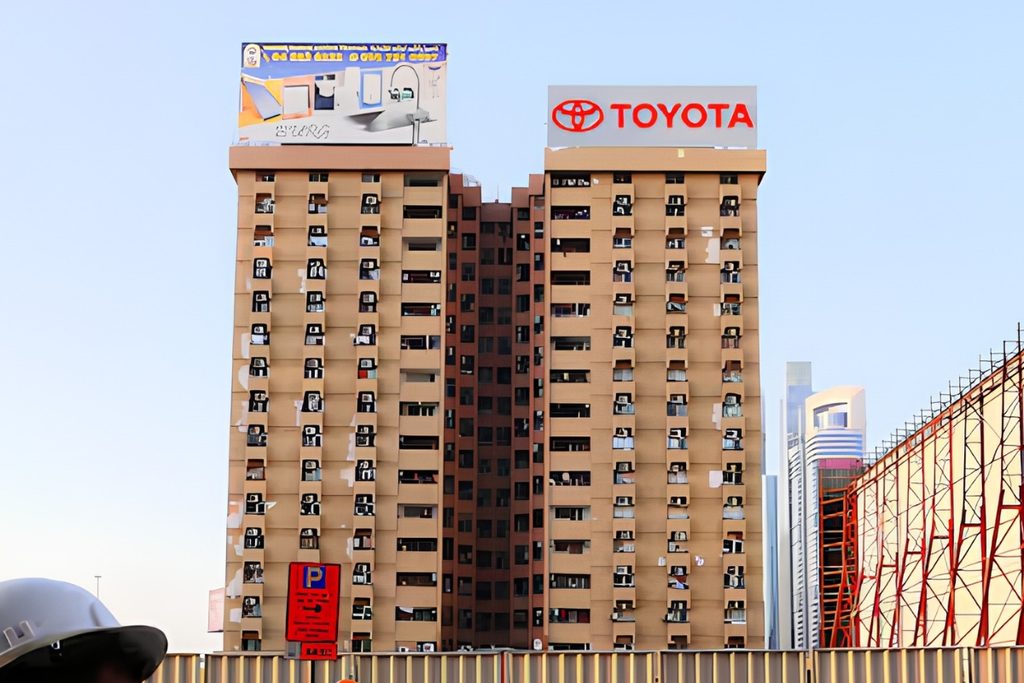
Before smartphones, digital maps and GPS became part of everyday life, landmarks were important navigation points. The bright Toyota logo became a familiar reference for people travelling along Sheikh Zayed Road and helped cement the building’s place in Dubai’s collective memory.
The sign was removed in 2018 after its advertising contract ended. Its absence did not last forever. In response to nostalgia among longtime Dubai residents, Toyota UAE and NRL Group reinstated the iconic billboard in June 2022.
Why is the building being demolished?
The planned demolition is linked largely to the building’s age and deteriorating condition. Reports have also raised concerns surrounding illegally partitioned apartments and overcrowding in some parts of the property.
Utility services have been disconnected in phases as residents leave, and property management has confirmed that the building is scheduled for demolition in 2027. An exact date has not yet been announced, and there is currently no confirmed information about what will replace the building.
Residents are already moving out
The farewell has already begun, with around 95 per cent of the building reportedly vacated.
NRL Group has confirmed that tenants with valid rental contracts can remain until December 2026. Some residents have already left following utility disconnections, while others are moving as the building prepares for its final months.
For long-term residents, the departure is understandably emotional. Some have spent years in the building and remember it as an affordable home in central Dubai. Its location, distinctive rooftop sign and connection to the city’s earlier years have given it a character that newer towers cannot easily replicate.
The end of a familiar Dubai landmark
The Dubai skyline has changed dramatically since the Toyota Building first appeared in 1974. Towers have risen around it, Sheikh Zayed Road has transformed, and neighbourhoods that were once distant parts of the city have become major destinations.
Yet the building remained a constant presence through much of that change. Its demolition in 2027 will mark the end of a 53-year chapter for one of Sheikh Zayed Road’s most recognisable residential landmarks.
Whatever eventually takes its place, the original Toyota Building will remain part of Dubai’s visual history, remembered by generations who knew exactly where they were whenever they saw that familiar red sign.